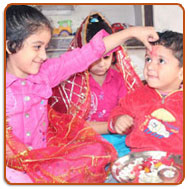


Customs and traditions are an inherent part of the rich Indian culture. In India, a lot of festivals occur one after the other, throughout the year. Each and every festival celebrated in India has its own social and cultural importance. Among these, one of the most significant and awaited festival is the Bhai Dooj festival. The festival is named Bhai Dooj as it focuses on the brothers, and celebrated on the second day after the new-moon (Amavasya), or Diwali day. This day is also the third day of the Kartik month, according to the Hindu calendar.
The basic theme behind the origination of the Bhai Dooj festival is believed to be the safety of women. But, there are also several mythological narrations associated with this festival. Two most popular stories are as mentioned below:
It is believed that once Yamraj (the god of death) visited her sister Yami. His sister became very delighted to see him and applied a tilak on his forehead. At this, Yamraj became so happy that he announced that the person whose sister will apply tilak on his forehead on that day would become free from the fear of death and hell. From that day, the tradition of Bhai Dooj came into existence.
Another mythological tale says that after killing the devil named, Narkasur, lord Krishna went to his sister Subhadra. The day on which lord Krishna visited his sister was the second day after the new-moon day, or the dooj day. Subhadra gave her brother a warm welcome by doing his arti, applying a tilak on his forehead, sprinkling flowers over him, and offering him sweets. From then onwards, it became a tradition and got fame as the Bhai Dooj festival.
On the auspicious and delightful occasion of Bhai Dooj, sisters apply tilak (a holy mark) on their brothers' forehead. They perform artiof their beloved and caring brothers and offer sweets to them, as well. Brothers also take pledge of their sisters' safety and give them some gift or present as a reciprocation. Bhai Dooj is really a great festival, which clearly reflects the customs and traditions of India.


Copyright © 2004- www.bhaidooj.org. All Rights Reserved